Goldmoney Review: Vaulted Gold With a $10 Monthly Floor
Goldmoney charges 0.5% to buy, 0.5% to sell and 0.25% a year to store gold, but a $10 monthly minimum changes the maths for small holders. We work out the break-even and what redeeming a bar really involves.
7.1/10
Sound, audited and cheap to trade at 0.5% each way, but priced for holders of real size. The $10 monthly storage floor means you need about $48,000 of gold before the 0.25% rate applies at all, and below that you pay more. Good for a large long-term store in named vaults. A poor fit for small buyers, or anyone who wants bars at the door.
Best for
Long-term holders with $50,000 or more who want audited, allocated metal
Buy and sell fees are only 0.5% each, a quoted price rather than a wide dealer premium
Metal is allocated and held outside Goldmoney's balance sheet, in named vaults
Vaults in six countries, run by Loomis, Brink's and the Royal Canadian Mint
Free funding by bank wire, SEPA and CHAPS
Quarterly and annual audits by BDO Canada, and a Toronto listing for the parent company
What does not
A $10 monthly minimum storage fee equals 2.4% a year on a $5,000 holding
Redeeming physical metal needs a whole bar, and third parties put the cost at 3% or more
Silver storage costs double the gold rate, at 0.50% a year
Bank withdrawals carry wire fees of $20 to $35 depending on currency
Specs
Buy fee
0.5% of the trade
Sell fee
0.5% of the trade
Gold storage
0.25% a year (0.020833% a month), all locations
Silver storage
0.50% a year
Minimum storage fee
US $10 a month on any holding
Break-even holding
About $48,000 in gold ($120 a year divided by 0.25%)
Funding fees
Free by bank wire, CHAPS and SEPA
Wire withdrawal fee
$25 USD, 25 EUR, 20 GBP, 35 CAD, 25 CHF per wire
Vault countries
Canada, Hong Kong, Singapore, Switzerland, UK, US
Metals
Gold, silver, platinum and palladium to London Good Delivery standards
Fee schedule date
Last updated February 1, 2026
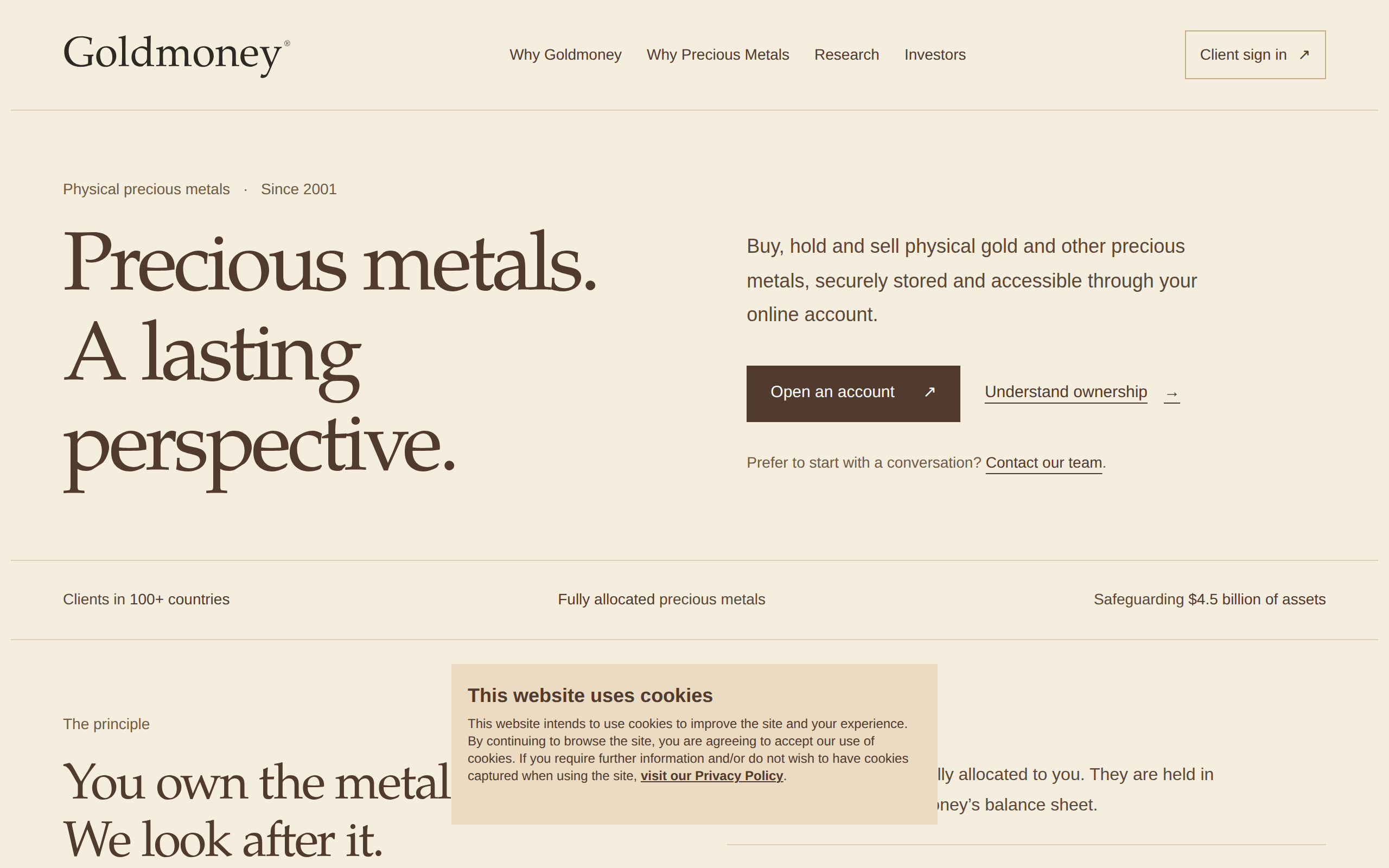
Every vaulted-gold service sells the same comfort: real metal, in a real vault, with your name on it. What separates them is the fee schedule, and Goldmoney's has one line that changes the verdict. A US $10 monthly minimum storage fee applies to any holding, however small.
This is a review, not personal advice. Gold prices move, and you can lose money holding it.
Start with the $10 floor
The headline rates look cheap. Goldmoney's fee schedule, last updated on 1 February 2026, charges 0.5% to buy and 0.5% to sell. Gold storage is 0.25% a year in every vault, taken monthly at 0.020833%.
Then the floor: if the storage fee on your metal comes to less than $10 in a month, you pay $10.
Do the arithmetic. $10 a month is $120 a year. Divide by 0.25% and you reach $48,000. Below that holding, the minimum applies, and the cost climbs as the balance falls:
$5,000 of gold pays $120 a year, an effective 2.4%.
$20,000 pays $120, an effective 0.6%.
$48,000 is the break-even where 0.25% takes over.
$100,000 pays $250, a flat 0.25%.
So this is not a service for someone who wants to put a few hundred dollars into gold each month. It is built for accumulated wealth. For smaller budgets, our BullionVault review and Vaulted review cover services with different fee structures.
goldmoney.com
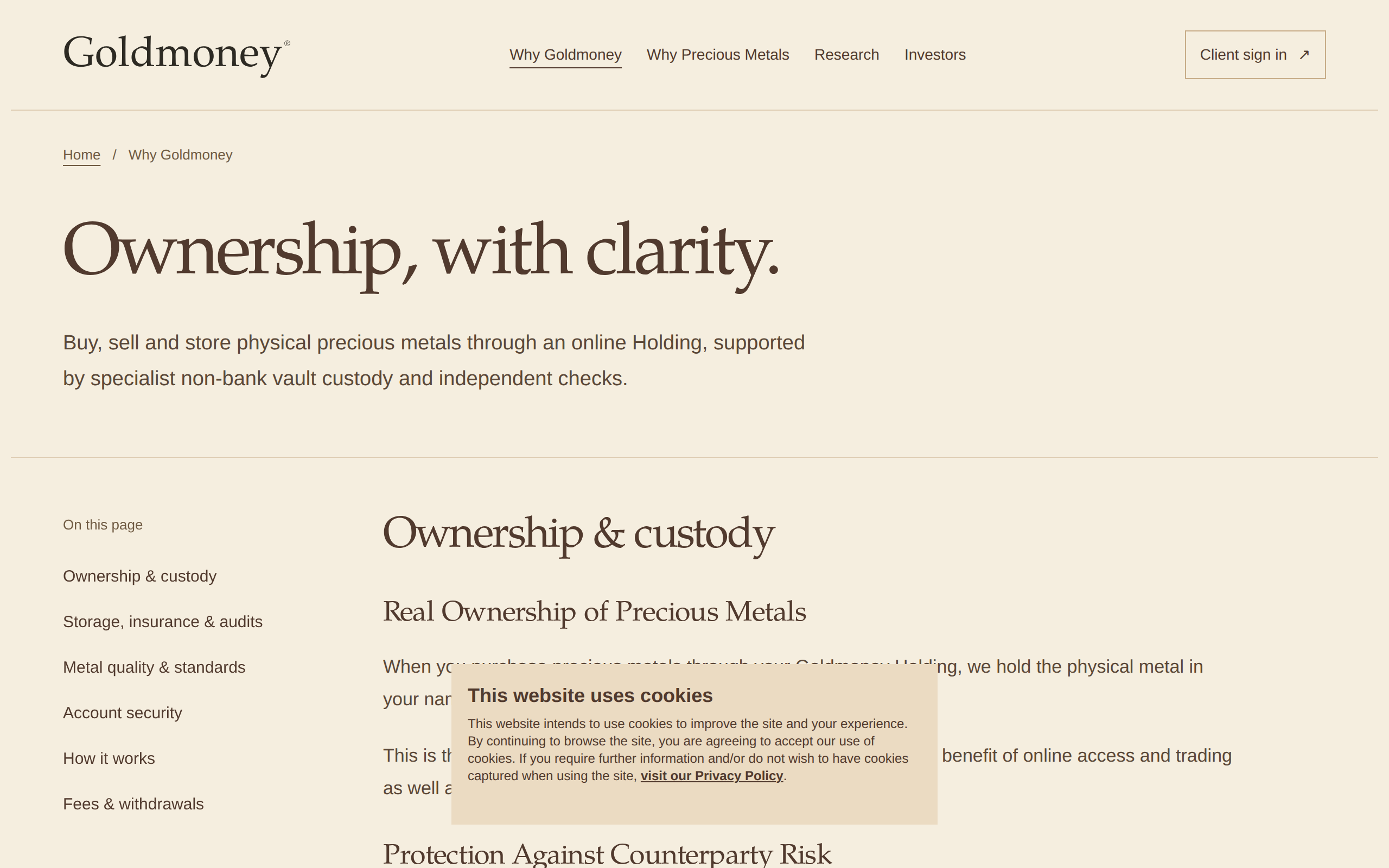
The Why Goldmoney page, where the company sets out how allocated metal is held in clients' names
What you actually own
This is where Goldmoney is strong. The company says clients own allocated metal directly, that settled metal is held outside its balance sheet, and that customer metal and vault holdings are matched one to one. Vaults sit in Canada, Hong Kong, Singapore, Switzerland, the UK and the US, operated by Loomis, Brink's and the Royal Canadian Mint. The ownership page lists BDO Canada LLP for quarterly and annual audits.
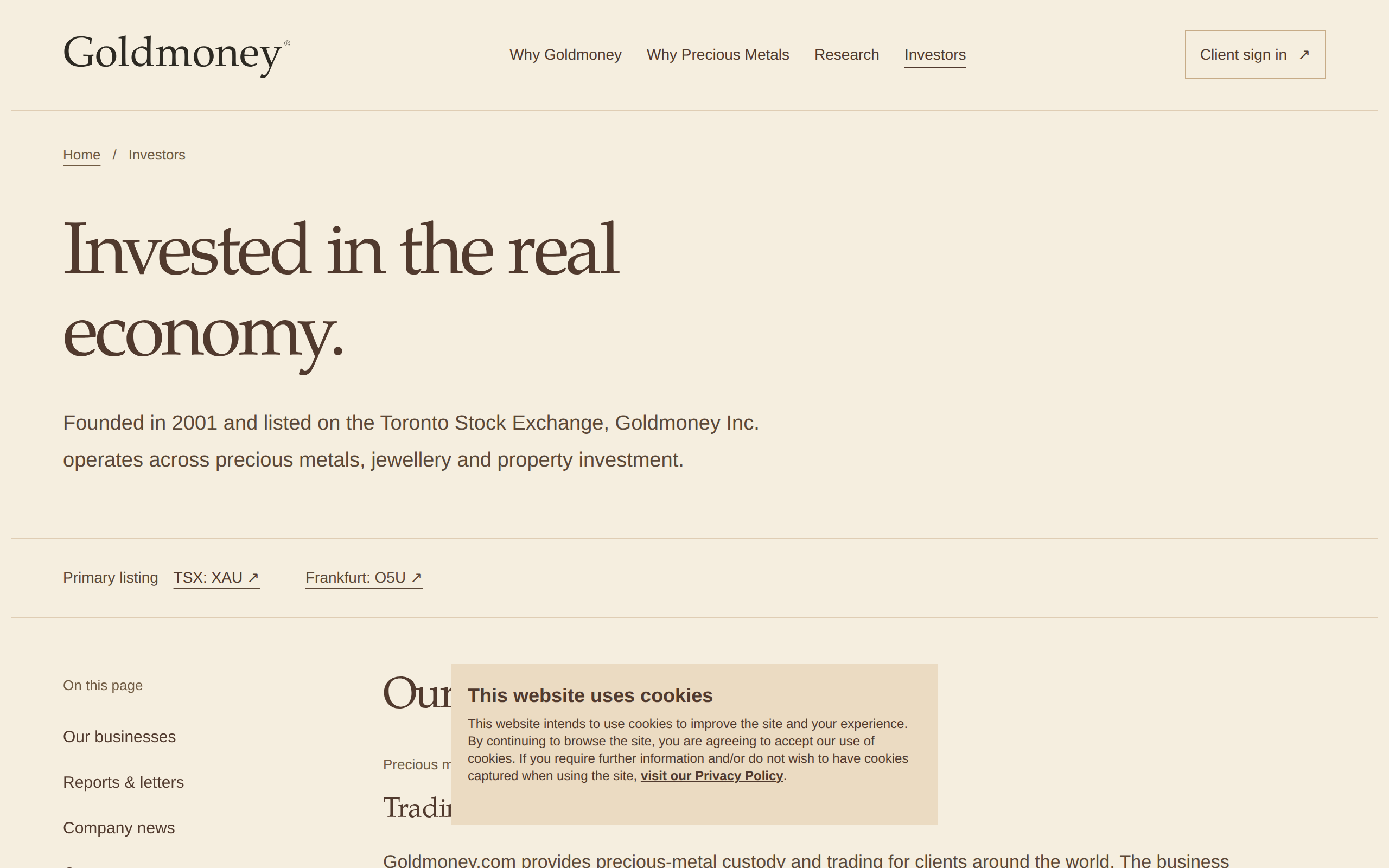
The parent, Goldmoney Inc., was founded in 2001 and is listed on the Toronto Stock Exchange (investor page). That gives outsiders public financial statements to read, which a private vault operator would not.
goldmoney.com
The investor page: Goldmoney Inc. describes its trading and custody business, founded in 2001 and listed on the TSX
We cannot audit a vault ourselves, so we treat these as the company's statements, backed by an auditor's name. They are better evidence than most competitors offer, but they are not proof.
Trading costs are the good part
A 0.5% fee each way costs 1% for a round trip. That is low for physical gold, where coin dealers often build their margin into premiums many times larger. Funding by bank wire, CHAPS or SEPA is free.
Getting money out is less pleasant. Goldmoney passes on its banks' charges: $25 for a US dollar wire, 25 euros for a euro wire (10 for SEPA), 20 pounds for a pound wire (7 for Faster Payments or CHAPS), and 35 Canadian dollars for a CAD wire. Small, but they bite on small sales.
The redemption problem
Here the "hold, spend and redeem" idea runs into reality. Goldmoney will arrange delivery or vault collection, but only if you hold enough metal to register a whole bar at that vault. The fee schedule lists a registration fee in metal for each bar type, for example 2 grams of gold on a 100 gram bar and 1.5 grams on a kilogram bar, and then says vault and administration costs are quoted per request.
An independent review (Gold Investment) puts the minimum at about $1,250 and the total cost at 3.0% for gold and up to 5.5% for palladium. We could not confirm those figures from Goldmoney's own page, so ask for a quote before you rely on them.
The word "spend" in the headline question needs a caveat too. The fee schedule we read is built around funding, buying, selling and bank withdrawals. We did not find a spending card or merchant payment feature we could verify as current, so we judge Goldmoney as a place to store and trade metal, not to pay with it.
goldmoney.com
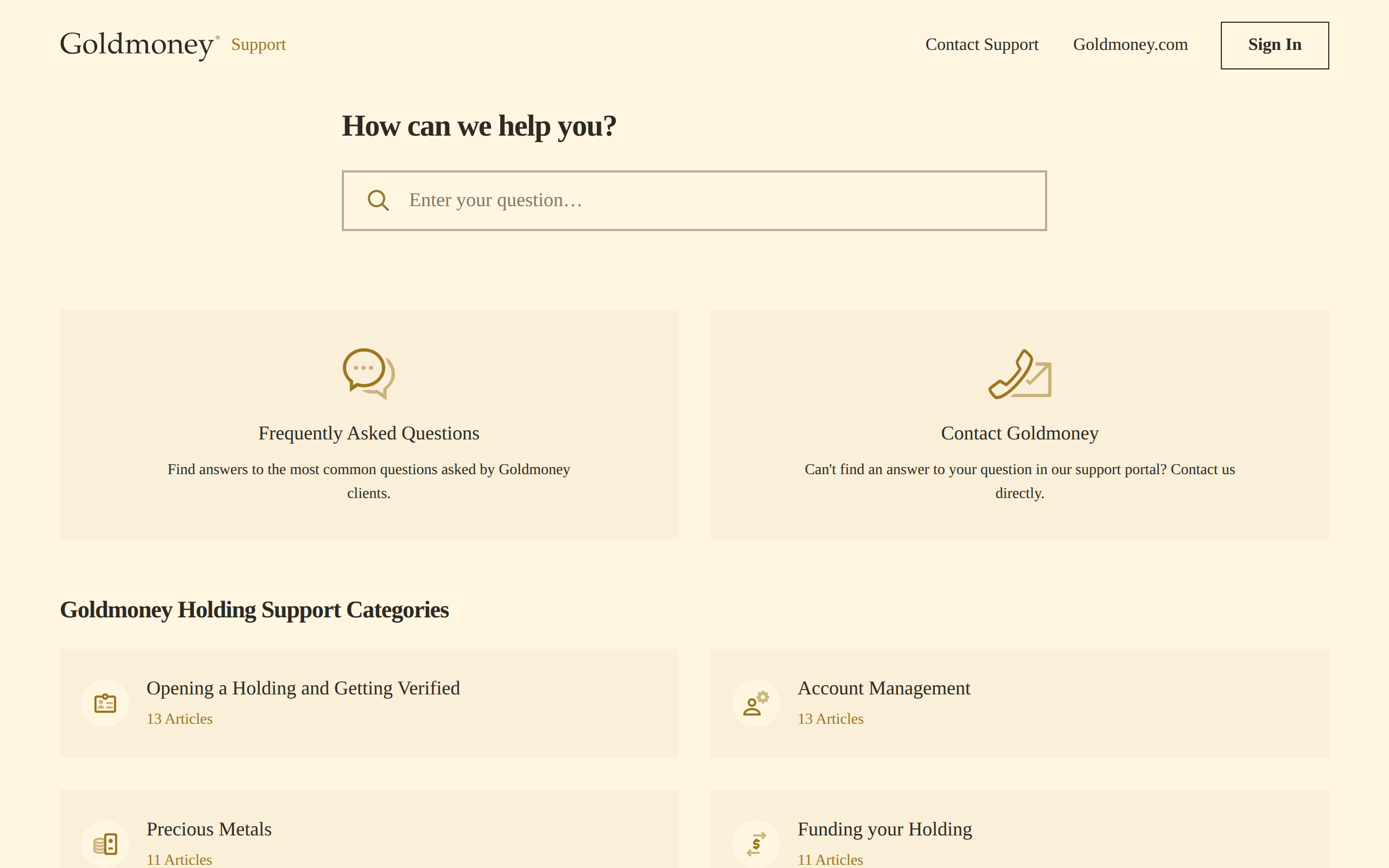
The support centre, where country eligibility for new accounts and other FAQs are kept
Also note that account availability varies by country. Check the support articles before you start, because an account you cannot open is a wasted afternoon.
Verdict
Goldmoney suits a holder with $50,000 or more who plans to sit on allocated metal for years, wants named vaults and audited statements, and does not need bars delivered. It does not suit small monthly buyers, active traders who want to pay fees on every swap, or anyone who wants to handle gold.
We score it 7.1. The trading fees and custody are strong, and the floor and the redemption rules hold it back.
6.2
Vaulted Review: Fractional Gold at the Royal Canadian Mint, Priced Fairly?