Fomo deposits and withdrawals: Apple Pay in, bank out
Fomo deposits and withdrawals run on Apple Pay and no minimum on the way in, and a three-business-day bank transfer on the way out. A desk review of what the company publishes about both, and what it does not.
6.9/10
Fomo deposits and withdrawals are the strongest part of this app: Apple Pay funding, no minimum deposit and a direct bank withdrawal the company puts at three business days, where a pure DEX offers no bank route at all. The cap on the score is cost and status — the rate on ordinary buys and sells is never published, and a USD balance here is not an insured deposit at a licensed venue. Fund it with money you can lose, and start the first withdrawal early.
Best for
Small-stake memecoin traders who want instant funding and a bank cash-out in one app
No minimum deposit, with sizing guidance that tells beginners to start at $25 to $50
Apple Pay funding is instant and uses EMVCo payment tokenisation, so the card number never reaches the app
Direct withdrawal to a linked bank account, company-stated at three business days, where a pure DEX has no bank route
One USD balance across supported chains, so no gas token or wallet setup is needed before a first trade
Specs
Minimum deposit
None stated
Funding methods
Apple Pay, debit card, crypto transfer
Account opening
Email or Apple ID; company-stated 30-second signup
Withdrawal route
Direct to a linked bank account
Withdrawal time
Within 3 business days (company-stated)
Published fees
$0 fee on first buy; 0.05% per transaction on Perps
Spot trading fee
Not published; shown in-app before you confirm
Custody
Non-custodial trading wallet; keys and seed phrase can be exported
Regulation
Not a licensed exchange, broker or bank; no deposit insurance
Backing
$75m Series B led by Index Ventures, June 2026
Every review on this desk is scored on five things, and one of them is money in and out: the methods, the minimums, and how long a withdrawal took. Fomo deposits and withdrawals are the most interesting part of this app, because the way money gets in is genuinely faster than the industry norm while the way money gets out is completely ordinary — and the distance between those two facts is this review.
How this review was done
Spreadcraft normally scores a product from an account we opened, funded and closed ourselves. This one is different, and that belongs at the top rather than in a footnote. Fomo is not a licensed broker or exchange. Its own Terms of Service say the Services “are not a DEX, exchange, or broker, and do not process any of your transactions”, which means there is no regulated entity to sign up with and no broker statement to reconcile against a fee schedule.
So this is a desk review. Every number below comes from Fomo’s own published material — the product pages, the Answers library and the Terms of Service — read in October 2026, and is attributed as a company statement wherever it is one. Nothing here is a timing we measured ourselves, and we would rather say that than dress a reading-based review up as a funded one.
Fomo deposits and withdrawals at a glance
Funding methods: Apple Pay, debit card and crypto transfer. Fomo’s own funding page lists Apple Pay first and describes it as instant.
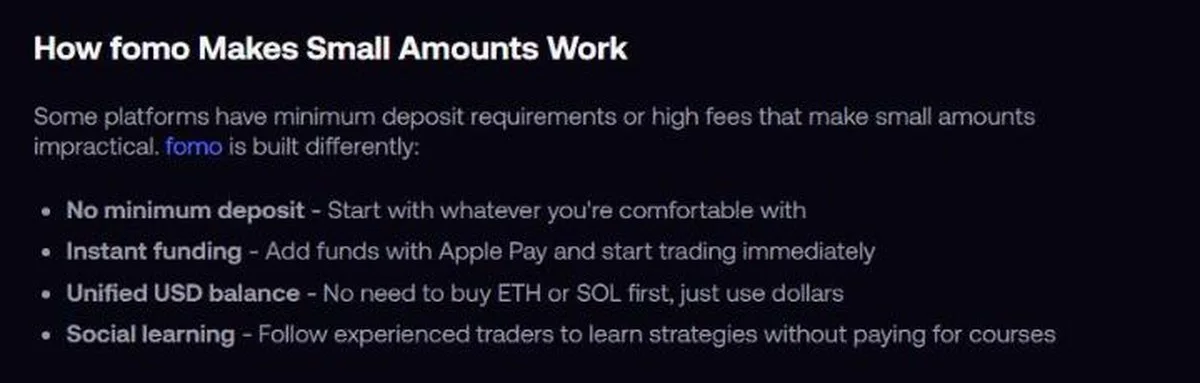
Minimum deposit: none. The company states “No minimum deposit - Start with whatever you’re comfortable with”.
Account opening: email or Apple ID, described by Fomo as a 30-second signup with no wallet setup.
Balance: a single USD balance that works across the chains the app supports, so there is no need to buy ETH or SOL before a first trade.
Withdrawal route: direct to a linked bank account.
Withdrawal time: “within 3 business days”, company-stated, with weekends and bank holidays on top.
Published fee numbers: $0 fee on first buy, and 0.05% per transaction on Perps. The percentage charged on ordinary buys and sells is not published anywhere.
Money in: Apple Pay, debit card and no minimum deposit
fomo.family
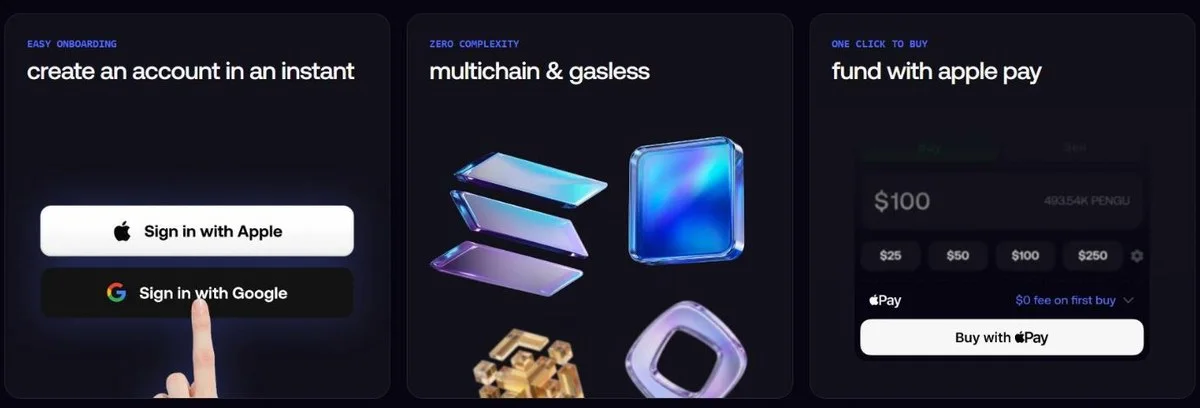
Fomo’s own feature cards: account creation, a unified balance, and Apple Pay funding with $25, $50, $100 and $250 presets.
The first half of Fomo deposits and withdrawals is the part that most clearly earns its score. The buy panel offers four preset amounts — $25, $50, $100 and $250 — an Apple Pay button and a “$0 fee on first buy” label. There is no wire form, no reference number to quote and no two-day wait before the money is usable.
That matters more than it sounds. On most crypto venues the first deposit is the step that loses people: a bank transfer that clears on day three, a card the issuer declines, a gas token that has to be bought before the token anyone actually wanted. Fomo removes all three at once, and its Answers library is explicit that this is deliberate — the company lists “Instant funding” and “Unified USD balance” as design choices rather than side effects.
The second piece is the minimum. Fomo states flatly that there is none, and pairs it with practical sizing guidance instead of a sales pitch: $25 to $50 is “enough to learn the mechanics with minimal risk”, $100 to $250 is “a common starting point for casual trading”, and a $50 stake is better split into $10 to $15 trades so there are three to five attempts rather than one. A platform that tells a beginner to start with less than it could ask for is being unusually honest about its own economics.
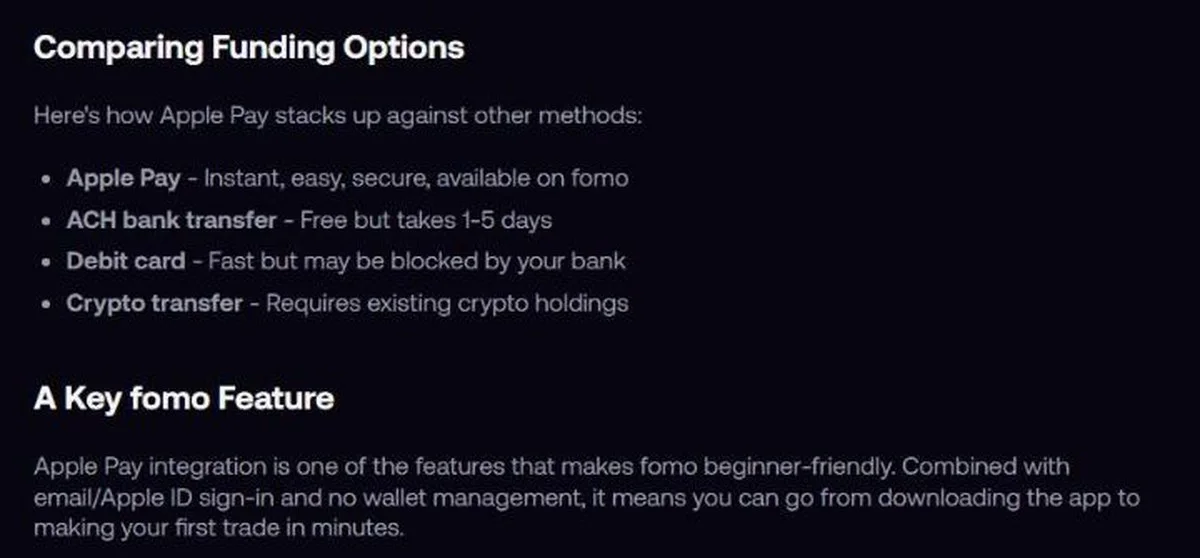
Fomo’s published comparison of funding methods, including the line conceding that the free route is the slow one.
Fomo publishes a side-by-side of funding methods, and it is worth reading closely because it concedes something.
Apple Pay - “Instant, easy, secure, available on fomo”
ACH bank transfer - “Free but takes 1-5 days”
Debit card - “Fast but may be blocked by your bank”
Crypto transfer - “Requires existing crypto holdings”
Read the second line again. Fomo’s own page says the slow method is the free one. The company does not publish what Apple Pay funding costs, so a reader cannot work out what the speed is worth in money. On a desk that weighs cost first, that is the honest shape of it: the convenience is real and the price of the convenience is undisclosed.
The security claim on that route is the one part a reader can check without trusting Fomo at all. Fomo says Apple Pay “uses tokenization and biometric authentication”. Payment tokenisation is a published industry standard rather than a vendor feature: EMVCo, the body that maintains the specification, describes it as technology that limits “the risk typically associated with compromised, unauthorised or fraudulent use of primary account numbers”. The card number itself does not reach the app. That is a genuine point in Fomo’s favour and it rests on somebody else’s standard.
Money out: three business days to a bank account
fomo.family
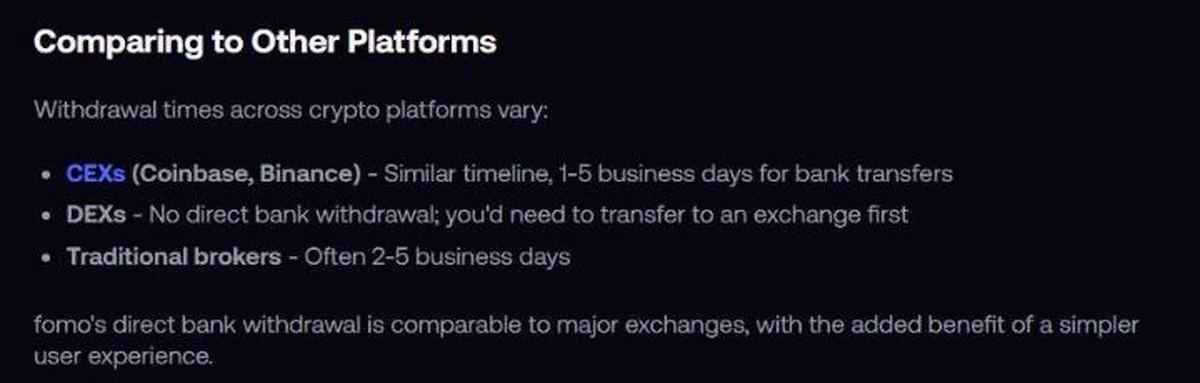
Fomo’s published withdrawal comparison, including the point that a pure DEX has no direct bank route at all.
Fomo states that a withdrawal request is “processed and funds arrive in your bank within 3 business days”, and lists what stretches that: a request filed late on a Friday, a slow receiving bank, a first-time withdrawal that triggers extra verification, and a large amount that gets additional review.
The company then compares itself, and this is the cleanest argument in the whole product:
Centralised exchanges - 1 to 5 business days for bank transfers
Traditional brokers - often 2 to 5 business days
Decentralised exchanges - “No direct bank withdrawal; you’d need to transfer to an exchange first”
Three business days is not fast by broker standards. What makes it count is the third line. A trader on a pure DEX has no exit to a bank account at all: getting dollars back means bridging to an exchange, passing that exchange’s checks and then waiting on its withdrawal queue. Fomo pairs DEX-style token access with a bank cash-out, and that combination is the reason Fomo deposits and withdrawals are worth a look in the first place.
Where the verification actually happens
Put two of Fomo’s own pages next to each other and something useful falls out.
The onboarding page promises a “30-second signup” with “no lengthy verification processes”. The withdrawal page says “First-time withdrawals may require additional verification”. Both can be true, and together they describe where the friction in Fomo deposits and withdrawals has been moved rather than removed: the identity check sits at the exit, not the entrance.
That is a sensible design for an app whose whole pitch is a first trade in under a minute, and it is also the single most important thing to know before funding. If money has to be out by a particular date, the first withdrawal is the one to start early — not because Fomo is slow, but because the check other platforms run before a deposit has not happened yet.
What the Terms say about moving tokens out
One restriction in the Terms is easy to miss and belongs in a money-out section. Among the rules Fomo passes through from its third-party providers, a user agrees that if they obtain “a digital collectible such as a meme coin or similar token”, they will not “swap such tokens into a traditional cryptocurrency (such as Bitcoin or ETH) and transfer the tokens to a wallet outside of Fomo”.
Read strictly, that limits one specific exit: converting a memecoin position into BTC or ETH and walking it off the platform. The bank route is untouched, and the Terms elsewhere confirm the trading wallet is non-custodial and that keys or a seed phrase can be viewed or exported, so the account is not a walled garden. We record the clause because it exists and because anyone planning to self-custody a position should read it before funding, not because we can tell you how it is enforced.
Costs on the way in and on the way out
fomo.family
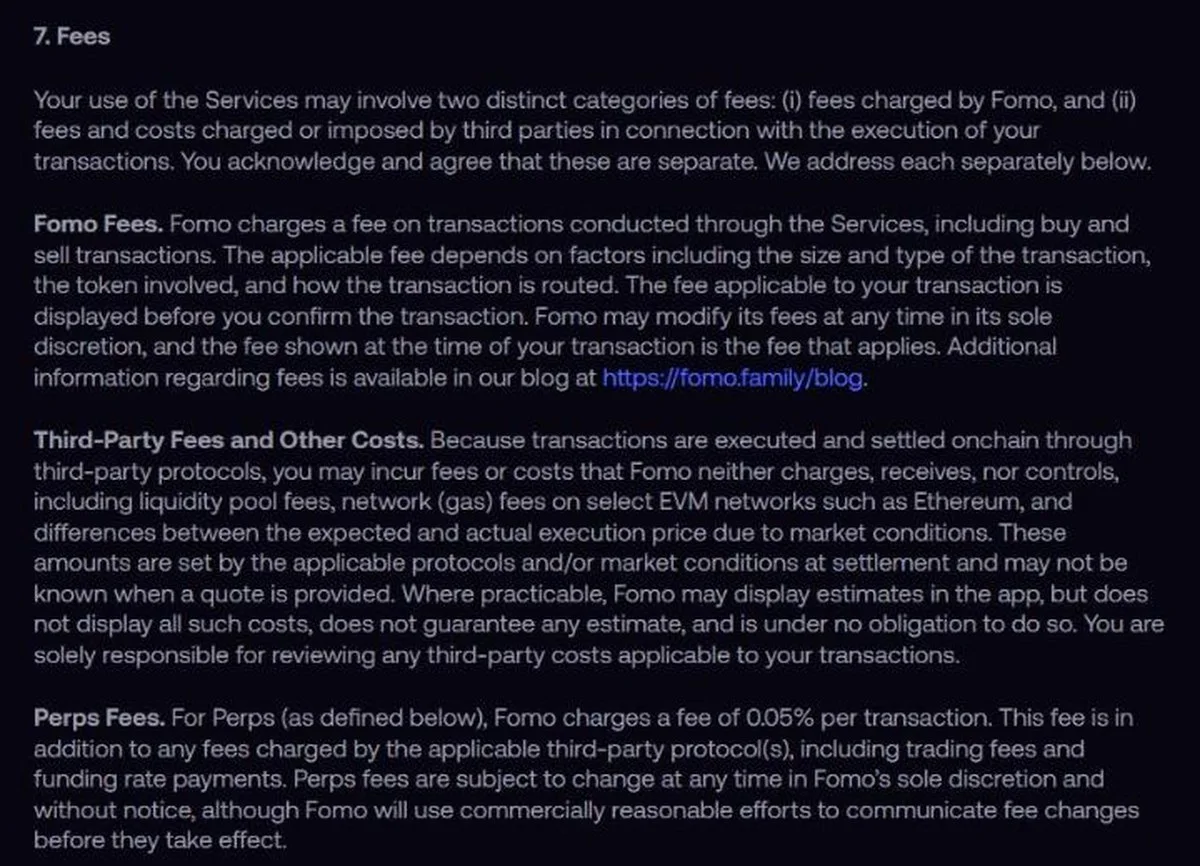
Section 7 of Fomo’s Terms, the only place the company sets out how its fees work.
Cost is the part of Fomo deposits and withdrawals that is hardest to pin down, and Section 7 of the Terms is the most informative page the company has published about it. It cuts both ways.
What it gives: the fee “is displayed before you confirm the transaction”, and “the fee shown at the time of your transaction is the fee that applies”. There is one hard percentage too — Perps are charged “a fee of 0.05% per transaction” — alongside the $0 fee on first buy that appears on the buy panel.
What it withholds: the rate on ordinary buys and sells. The Terms say the fee “depends on factors including the size and type of the transaction, the token involved, and how the transaction is routed”, which describes a formula without giving it. And on everything charged by somebody else — liquidity pool fees, network gas, the gap between quoted and executed price — Fomo writes that it “may display estimates in the app, but does not display all such costs, does not guarantee any estimate, and is under no obligation to do so”.
The fair summary: Fomo shows its own fee before you commit, and states in writing that it may not show all the others. That is more disclosure than this app usually gets credit for and less than a published schedule, and on a desk that scores cost first it is what caps the number.
Safety: what a USD balance inside Fomo is not
fomo.family
Fomo’s own summary of why small stakes work on the platform.
A smooth route in and out only means something if the money is safe while it sits there, so three things need saying without softening.
A USD balance inside Fomo is not a bank deposit. There is no deposit insurance, no client-money segregation rule, no compensation scheme and no regulator to complain to. The Terms put the custody position in capital letters: the trading wallet is non-custodial and the user is “SOLELY RESPONSIBLE FOR SAFEGUARDING ACCESS TO IT”, including the email account or Apple ID used to recover it. Losing access to that email is losing the balance.
Who stands behind it reads better than the licensing does. FOMO Labs Inc. announced a $75 million Series B led by Index Ventures in June 2026, with Union Square Ventures and Benchmark participating. That is not a licence and it protects not one dollar of customer money, but on the narrow question of whether the company will still be there in three business days, it is real evidence.
And the service is not offered everywhere. The Terms name the Crimea region, Cuba, Donetsk, the Democratic Republic of Congo, Iran, Libya, Luhansk, Myanmar, North Korea, Sudan, Venezuela and Yemen, plus any country under US, UK or EU embargo and any jurisdiction where transacting in cryptocurrency is prohibited or restricted. Check your own before funding.
Who this suits, and who should skip it
Fomo deposits and withdrawals do one job unusually well: moving a deliberately small, losable stake into new tokens without a three-day wait, and moving the proceeds back to a bank without a detour through a second exchange. On that job Fomo beats both obvious alternatives, and the absence of a minimum means the job can be tried for $25.
It does not suit anyone who needs a published fee schedule before trading, anyone who wants a regulated venue with segregated client money, or anyone sizing a position they could not watch go to zero. Those are not small objections, and no amount of onboarding polish answers them.
Trading leveraged products such as forex and CFDs carries a high risk of losing money quickly. Crypto assets are volatile and largely unregulated. Nothing on Spreadcraft is personal financial advice.
Memecoins and newly launched tokens are among the most speculative assets available to retail buyers and can lose all of their value. Fomo is not a licensed exchange, broker or bank: balances are not insured, there is no compensation scheme, and the non-custodial design means losing access to your sign-in credentials can mean losing the funds. Fomo publishes a three-business-day withdrawal timeline but does not publish the percentage it charges on ordinary trades. Treat anything funded as money you can afford to lose entirely.