E8 Markets review: do its own terminal and flexible drawdown help a forex trader?
E8 sells simulated funded accounts with a drawdown you can pick, but its in-house terminal only covers perpetual futures. We read the rules for forex and priced every tier.
7.1/10
E8 is a fair, cheap-to-enter prop firm whose flexible drawdown is real: E8 One's loss level locks once you bank profit, and Pro is fully static. But its own terminal is for perpetual futures only, so a forex trader ends up on TradeLocker, Match-Trader, cTrader or MT5 like everywhere else. Skip it if you want a fast first payout on a small account.
Best for
Forex traders who want to choose their drawdown style
We went into E8 Markets with a narrow question. The firm advertises its own trading terminal and a menu of drawdown styles. For someone who trades EUR/USD and gold, does either change the outcome? One answer turned out to be no, and the other is a qualified yes.
The terminal is not for forex
E8's help centre calls the E8 Terminal "our own trading platform" built for its SimFi environment, with a live objective tracker and drag-and-drop stop losses. It runs on a Hyperliquid feed. That is a perpetual futures venue, and the same article says the terminal serves the Perpetual Futures market only.
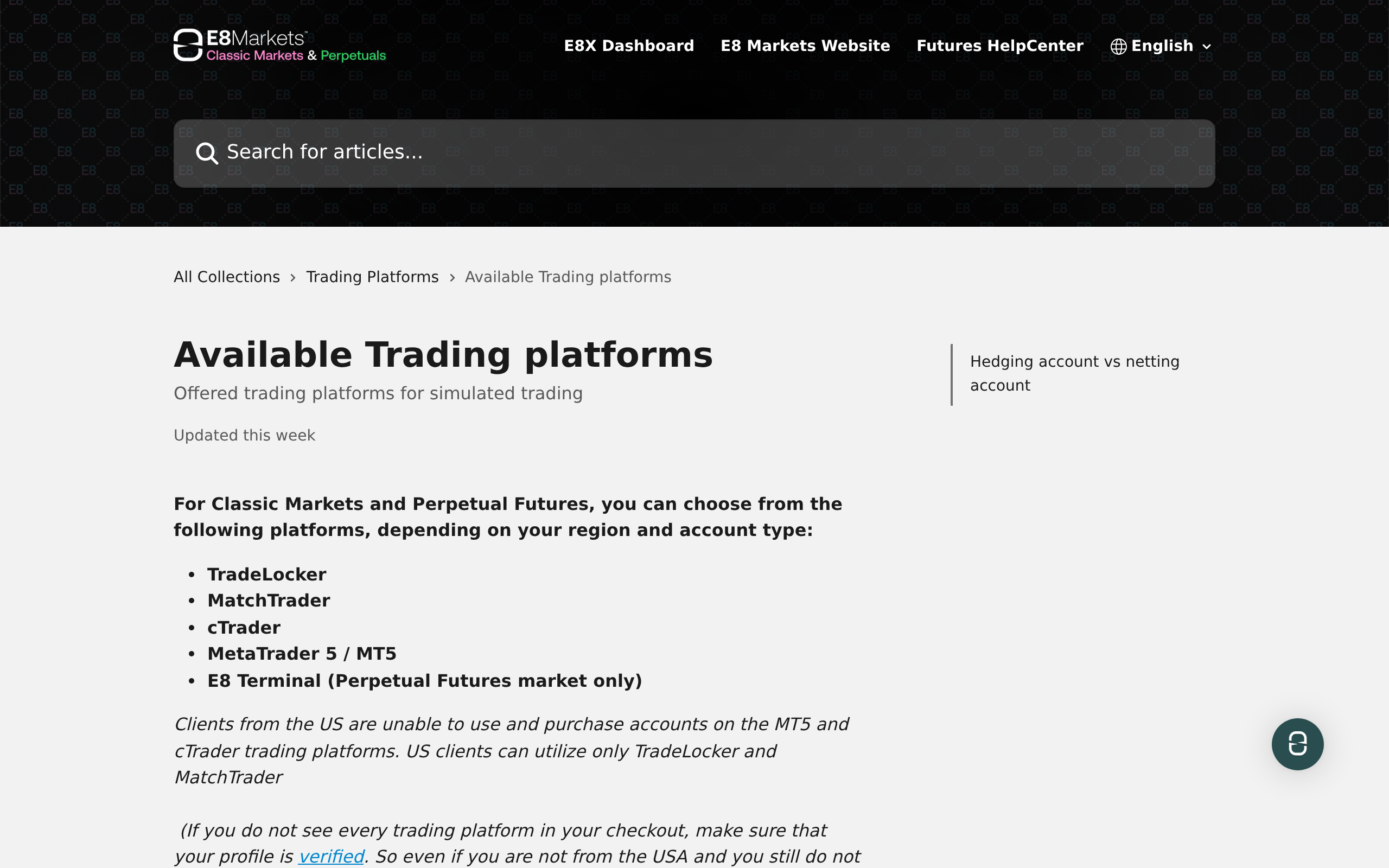
Forex accounts run on the platforms every prop firm offers: TradeLocker, Match-Trader, cTrader and MT5. Availability depends on where you live. US clients cannot buy MT5 or cTrader accounts and are limited to TradeLocker and Match-Trader. cTrader adds $10 on accounts priced under $100.
e8markets.com
E8's own list of platforms, with the regional limits and the note that the E8 Terminal is for perpetual futures.
Forex and crypto accounts use a hedging system, so you can hold a buy and a sell on the same pair. Hedging opposite trades across two E8 accounts is banned, though. Leverage is 1:30 on forex and 1:15 on metals, indices and energies, and it does not change between the challenge and the funded stage.
What the fee ladder looks like
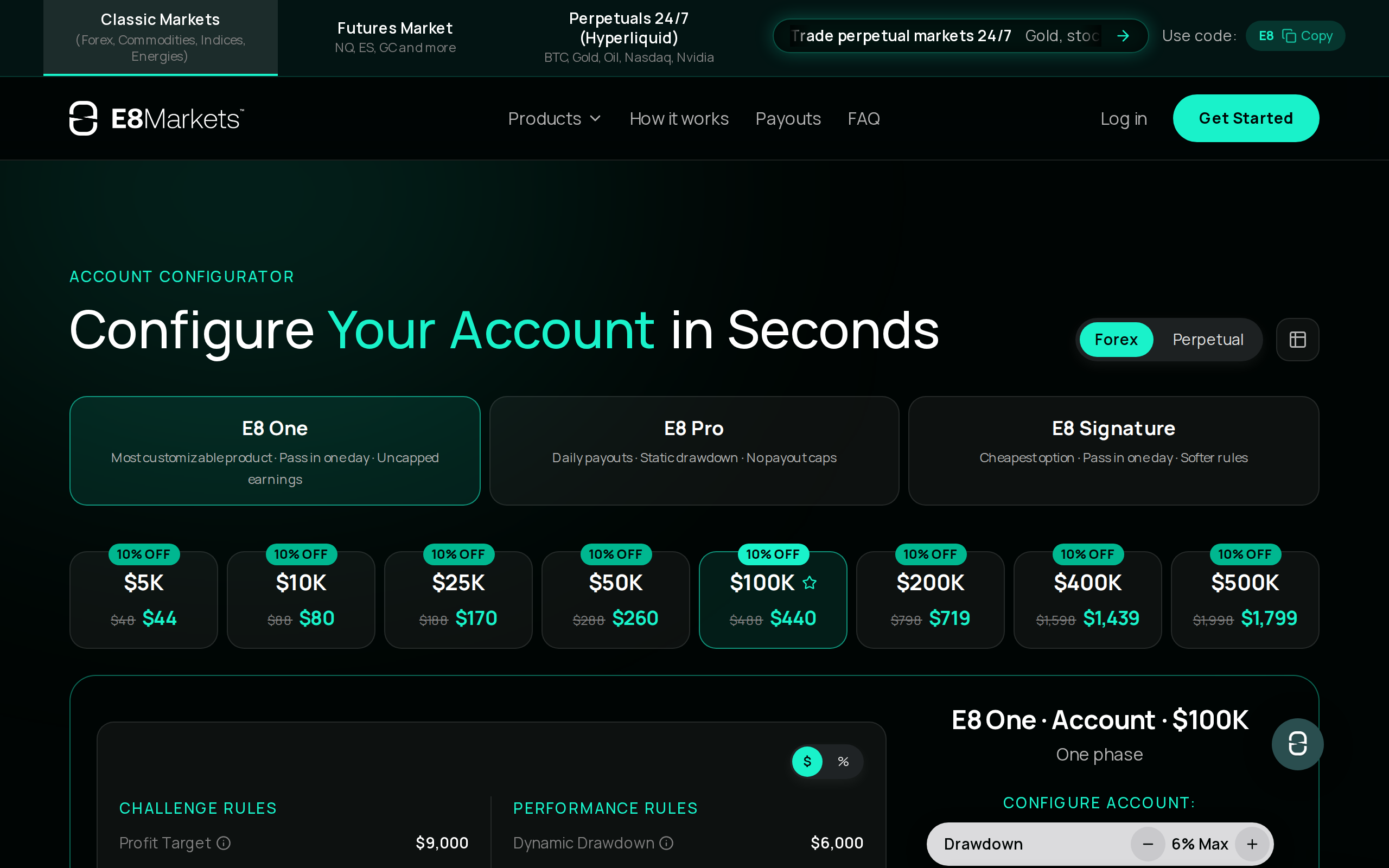
Fees are one-time. Across the range, the list price runs from $48 for a 5K account to $1,998 for 500K, and the site advertises a 10% first-order code that brings the smallest to $44. On the 100K size we saw three prices.
e8markets.com
The account configurator: sizes from 5K upward, with the list price and the discounted price side by side.
None lists an activation fee, and there is no challenge deadline. For comparison with a bigger name, see our FTMO review, where the fee is higher and the rules are stricter.
Where the flexible drawdown earns its name
The drawdown is the real product here, so it deserves a closer look.
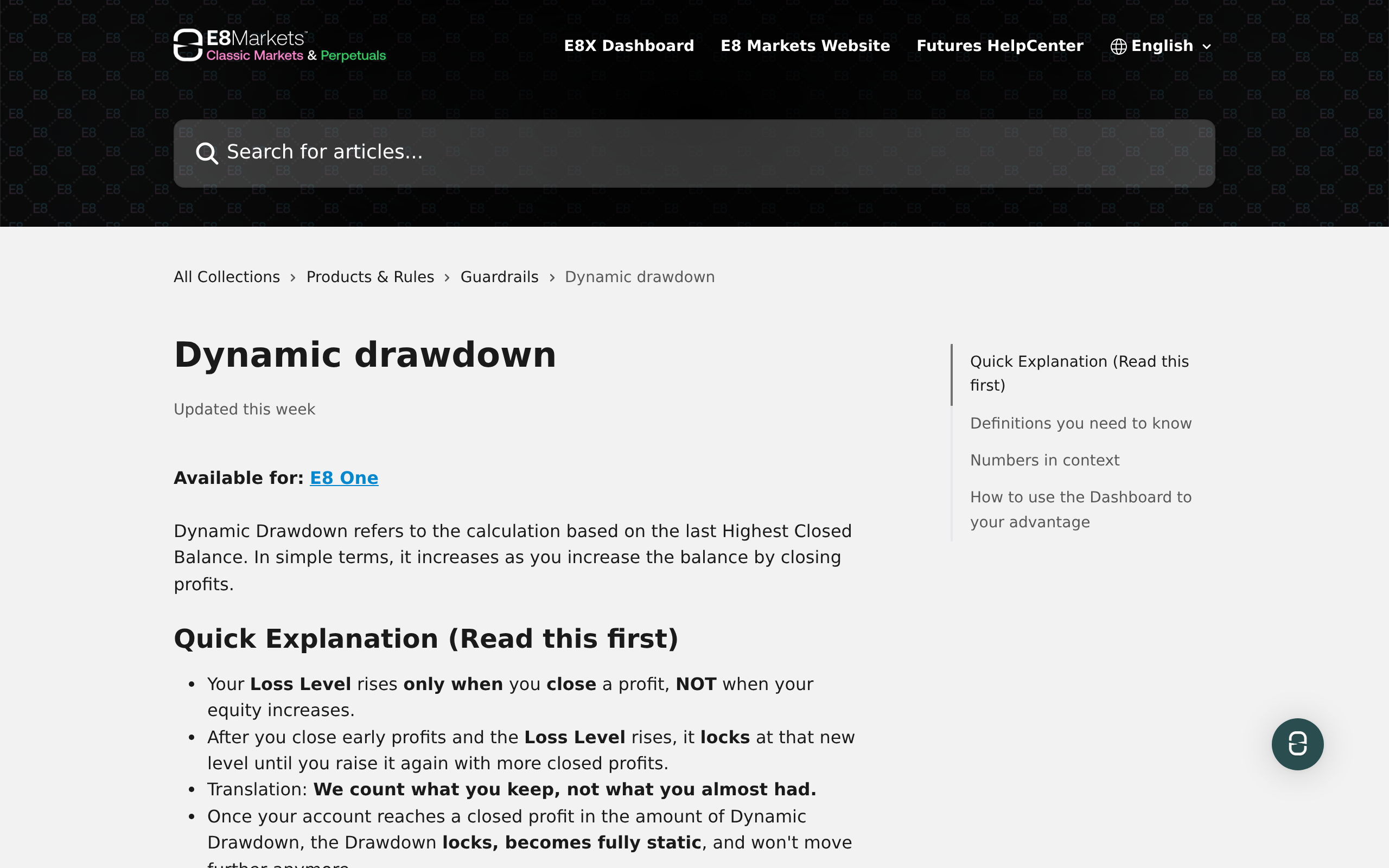
E8 One uses a dynamic drawdown measured from your highest closed balance. The loss level moves up only when you close a profit, not when floating equity rises. Once closed profit equals the drawdown amount, the level locks at the starting balance and stops moving. Swing traders are not punished for open profit that later reverses, which is the usual complaint about trailing rules. You can also choose the drawdown at checkout, from 4% to 14% according to third-party reviews, with the fee moving accordingly. We saw 6% as the default on the 100K size.
e8markets.com
E8's own explanation: the loss level rises only when a profit is closed.
E8 Pro is the plainest: a static $6,000 loss limit, a $2,500 daily drawdown, and a daily profit cap of 2% of the starting balance. Anything above $2,000 on a 100K account in one day adds to the balance but does not count toward your results. That cap punishes exactly the news-day trader who makes a month of profit in an afternoon.
E8 Signature is the cheap, tight option, with a 3% end-of-day drawdown, a daily pause and a 35% consistency rule.
Payouts: 80%, but through a middleman
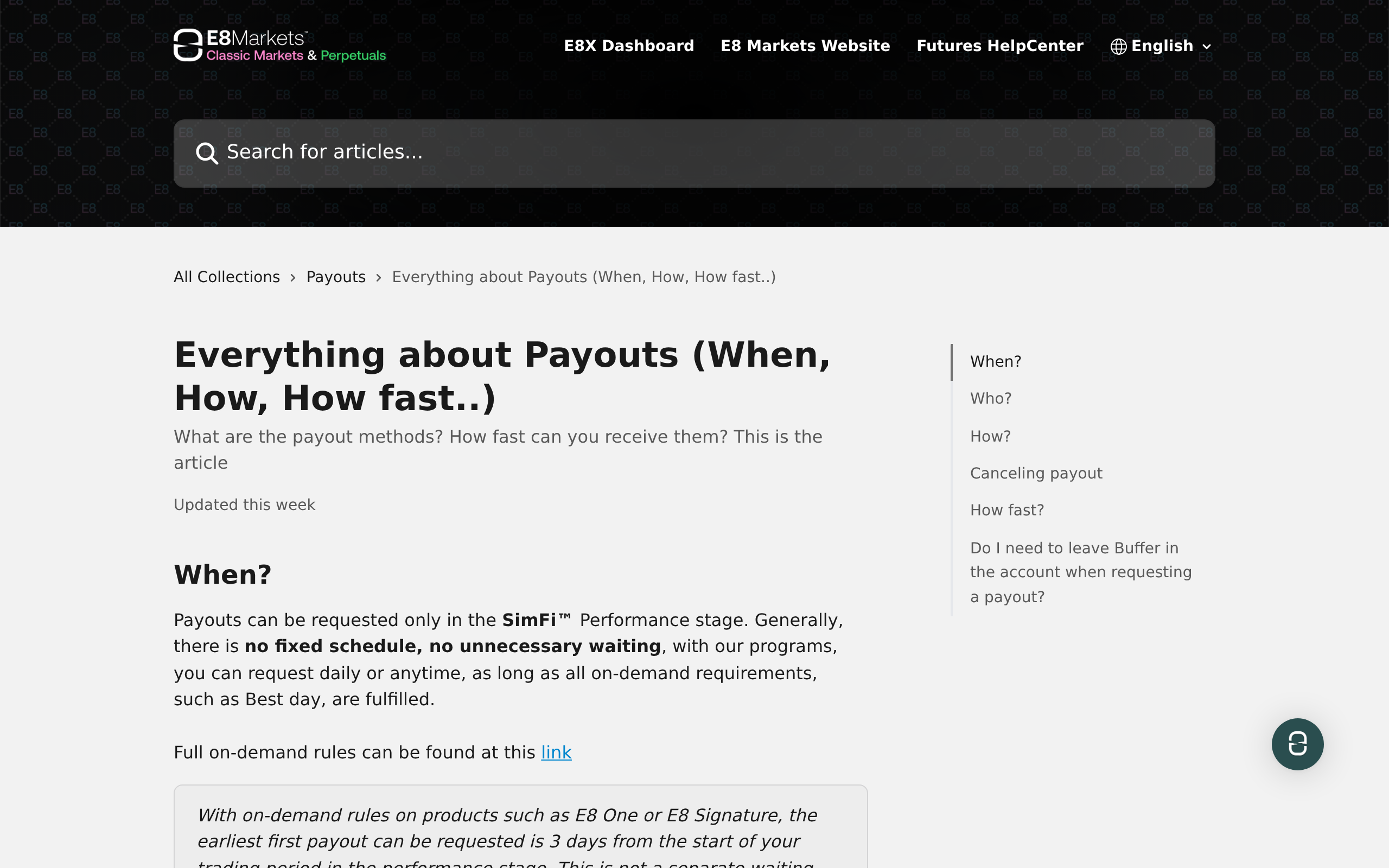
Payouts start only in the funded ("Performance") stage. E8 One and Signature are on-demand, subject to the best day rule. Your best single day cannot exceed 40% of total profit on E8 One, or 35% on Signature. In practice the earliest first payout is day three, and E8 quotes an average first payout of $5,838 on E8 One 100K, $1,603 on Pro and $1,967 on Signature. Those are the firm's own figures, not ours.
The split is 80% on the sizes we checked, with "up to 100%" advertised for higher tiers. E8 charges no payout fee, but money moves through WorkMarket, Rise or Aeropay (US only). There is no direct crypto payout, and if you fail a provider's KYC you cannot be paid.
e8markets.com
Payout rules from E8's help centre: performance stage only, third-party processors, no direct crypto.
The part the headline skips
Every account is simulated. E8's own legal text says users never risk or deposit capital for investment, and outcomes are hypothetical. That is common in the industry, but it means "funded" describes a pay arrangement, not real market access.
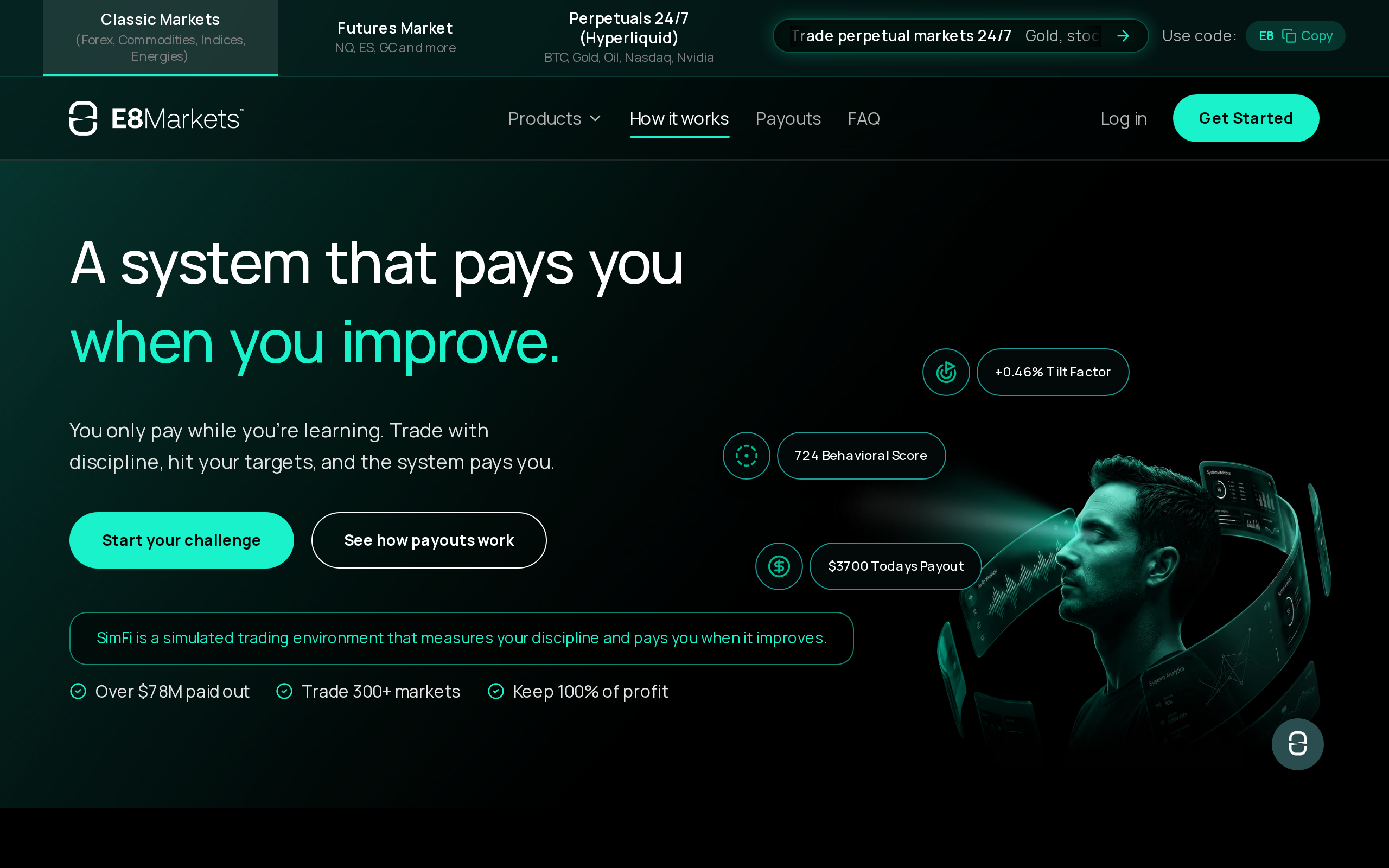
The how-it-works page also states that roughly 1 in 5 traders pass. We appreciate that they publish it. A 20% pass rate on a $488 fee is still a bad-odds purchase unless your edge is proven elsewhere.
e8markets.com
The how-it-works page, where E8 states its pass rate and its four-step process.
Who should buy it
Buy E8 One if you hold trades for days and want a drawdown that stops chasing you once you are ahead. Buy Pro if you want a static floor and never make more than 2% in a day. Skip E8 entirely if you scalp news, if you need a payout inside a week on a small account, or if you cannot pass a third-party KYC check in your country.
Compare it against FundedNext and The5ers before paying. Risk warning: trading leveraged products carries a real risk of loss, and simulated results do not predict live ones. This review describes rules, not a recommendation for your circumstances, and it is not personal advice.
7.9
Topstep Review: Is a Futures Combine Better Than a Forex Prop Firm?